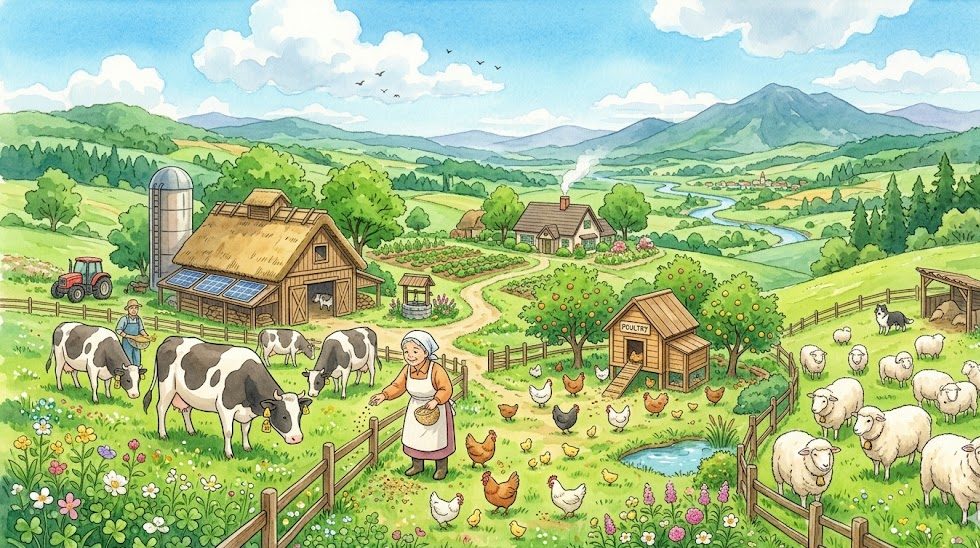
Sustainable animal husbandry is the practice of raising livestock in a way that is economically viable, environmentally sound, and socially responsible. Unlike industrial farming, which often leads to land degradation, sustainable techniques focus on the health of the animals and the regeneration of the soil. By mastering the integration of dairy, poultry, and sheep farming, producers can create a resilient agricultural ecosystem.
1. Sustainable Dairy Farming: Quality Over Quantity
The heart of sustainable dairy farming lies in the management of the herd and the land they graze upon.
Rotational Grazing Systems
Instead of keeping cows in a single pasture until the grass is depleted, sustainable farmers use Rotational Grazing.
- The Technique: Divide the pasture into smaller “paddocks.” Move the herd to a fresh paddock every 1-3 days.
- The Benefit: This prevents overgrazing, allows the grass to recover naturally, and ensures the cows always have access to the most nutrient-dense forage. It also helps in natural carbon sequestration.
Animal Health and Nutrition
In a sustainable setup, the focus is on “Prevention rather than Cure.”
- Natural Feed: Reducing reliance on soy-based concentrates and moving toward grass-fed models.
- Waste Management: Using an anaerobic digester or composting system to turn manure into “Bio-fertilizer,” which is then applied back to the pastures, closing the nutrient loop.
2. Poultry Management: The Mobile Revolution
Poultry is one of the most efficient ways to produce protein, but traditional cage systems are neither sustainable nor ethical.
Pastured Poultry and “Chicken Tractors”
One of the best modern innovations is the use of mobile coops, often called chicken tractors.
- Soil Fertilization: As chickens move across the field, they eat pests and weed seeds while leaving behind nitrogen-rich droppings that act as an instant fertilizer.
- Pest Control: Chickens are natural predators for many larvae and insects that could otherwise damage crops or irritate larger livestock.
Breed Selection
Mastering poultry farming requires choosing the right breed for your climate. Sustainable farmers often opt for “Heritage Breeds” which, while slower to grow than industrial hybrids, are much more resilient to local diseases and environmental stress.
3. Sheep Farming: The Eco-Friendly Weed Managers
Sheep are the “low-maintenance” heroes of animal husbandry. They are excellent for land that is too hilly or poor for cattle.
Silvopasture Integration
Sheep thrive in Silvopasture systems—the practice of integrating trees with livestock grazing.
- Shade and Shelter: Trees provide animals with protection from extreme heat, reducing stress and improving growth rates.
- Diversified Income: The farmer gets wool and meat from the sheep, and timber or fruit/nuts from the trees.
Parasite Management without Chemicals
Internal parasites are a major challenge in sheep farming. Sustainable techniques include:
- Co-grazing: Running sheep and cattle together. Since most parasites are species-specific, cattle will eat and neutralize sheep parasites, and vice versa.
- Genetic Selection: Breeding sheep that show a natural resistance to local parasites, reducing the need for chemical dewormers.
4. The Power of Integrated Livestock Systems
The true “Mastery” comes when you combine these three species on one farm. This is often called Multi-Species Grazing.
- The Succession Effect: Cows eat the tall grass, followed by sheep who eat the shorter, finer weeds that cows dislike. Finally, poultry are brought in to pick through the manure, spreading it out and eating the fly larvae.
- Disease Breaking: Most pathogens cannot jump from a bird to a cow or a sheep. By rotating different species through the same land, you naturally “break” the life cycle of pests.
- Financial Stability: If the price of milk drops, the farmer still has income from wool, eggs, and meat. Diversification is the ultimate insurance policy.
5. Modern Tech Innovations in Husbandry
Even in a nature-focused system, technology (Smart Farming) plays a massive role.
- Smart Collars: GPS-enabled collars for cows and sheep that monitor health metrics and allow for “Virtual Fencing,” eliminating the need for physical wires.
- Automated Watering Systems: Using sensors to ensure livestock always have access to clean, fresh water without manual refilling.
- Health Tracking Apps: Digital ledgers that track vaccination schedules, weight gain, and breeding cycles to optimize the farm’s output.
6. The Economic Case for Sustainability
Transitioning to sustainable animal husbandry isn’t just about the environment; it’s about the bottom line.
- Lower Input Costs: By producing your own fertilizer (manure) and feed (pasture), you reduce the massive costs associated with chemical fertilizers and commercial grains.
- Premium Markets: Products like “Grass-Fed Beef,” “Pasture-Raised Eggs,” and “Organic Wool” command significantly higher prices in the global market.
- Longevity: Sustainable farms are more resilient to climate change, ensuring the business survives droughts or floods that would bankrupt a conventional farm.
Conclusion: Building a Harmonious Farm
Mastering dairy, poultry, and sheep farming requires a deep understanding of animal behavior and ecosystem dynamics. By shifting the focus from “extraction” to “regeneration,” farmers can build a business that provides high-quality food while leaving the land better than they found it.
For an entrepreneur, this integrated approach is the gold standard of modern agriculture—efficient, ethical, and highly profitable.