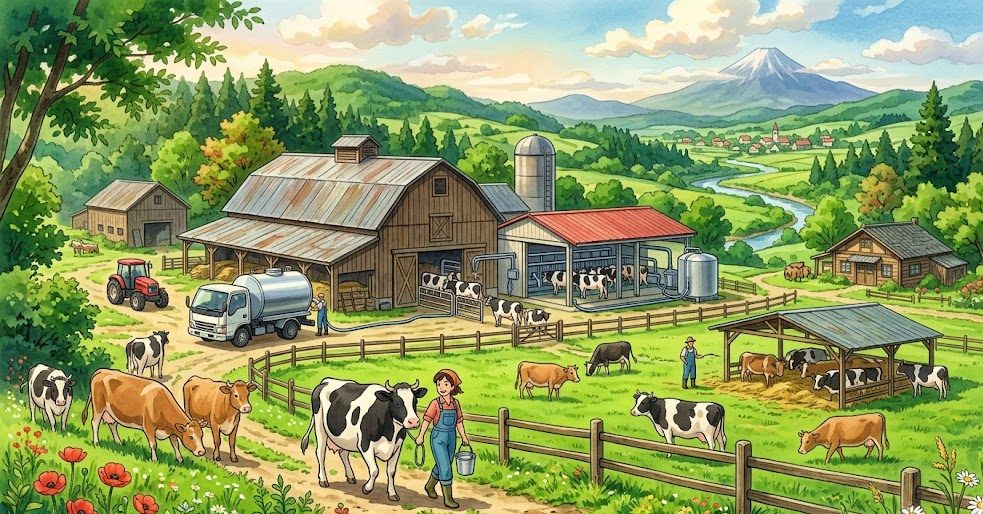
The global dairy industry is an evergreen pillar of commercial agriculture. Milk and dairy derivatives—such as butter, cheese, yogurt, and ghee—remain structural staples in human nutrition worldwide. As urban populations expand and disposable incomes rise, the demand for high-quality, unadulterated milk continues to skyrocket.
However, running a profitable dairy enterprise is no longer just about owning a few cows and selling milk locally. Modern Dairy Farming has evolved into a highly technical agritech business. Success in this domain depends heavily on precision Cattle Management, optimized nutrition, and advanced Milk Production workflows.
Whether you are looking to set up a new commercial dairy farm or upgrade an existing livestock facility, this comprehensive guide provides the blueprint for maximizing your daily milk yields and securing excellent profit margins.
1. Choosing the Right Breeds for Commercial Dairy Farming
The foundational step of an elite dairy farm is selecting the right cattle breed. Your choice will dictate your daily milk yield, feed conversion ratios, and climate resilience. Commercial dairy farming generally categorizes cattle into two streams: high-yielding exotic breeds and resilient indigenous breeds.
Top High-Yielding Dairy Breeds:
- Holstein Friesian (HF): Originating from Europe, HFs are the undisputed kings of milk volume, capable of producing 25 to 40 liters of milk per day under optimal conditions. They thrive best in temperature-controlled environments.
- Jersey: Known for producing milk with an exceptionally high butterfat and Solid-Not-Fat (SNF) content. Jerseys are highly adaptable, heat-tolerant, and consume less feed than HFs.
- Sahiwal & Gir: Premium indigenous breeds highly popular in tropical regions like India. While their daily volume is lower than exotic breeds, their milk contains the highly sought-after A2 beta-casein protein. Furthermore, they possess natural immunity against tick-borne diseases and extreme heat waves.
2. Advanced Cattle Management Practices
To keep a dairy herd performing at peak efficiency, farmers must treat cattle health and comfort as top operational priorities. Stress directly reduces a cow’s milk output.
A. Modern Housing Infrastructure
Gone are the days of keeping cattle tied up in dark, cramped sheds. Modern commercial farms use Free-Stall Barns where animals can move, eat, and rest freely.
- Ventilation: Industrial-grade overhead fans and misting systems are mandatory to combat heat stress, which can drop milk yields by up to 20%.
- Bedding: Utilizing rubber mats or deep sand bedding prevents lameness and hock injuries, ensuring cows spend more time resting and ruminating.
B. Smart Health and Reproduction Tracking
A dairy farm is only profitable if its cows calves regularly. Managing the “calving interval” is a critical business metric.
- A.I. (Artificial Insemination): Utilizing sexed semen from elite bulls ensures a 90% chance of female calf births, helping you scale your milking herd quickly.
- IoT Biometric Collars: Modern smart collars track rumination cycles and body temperature changes. They automatically alert the farm manager via smartphone when a cow is in heat or showing early signs of mastitis.
3. Precision Nutrition: The Total Mixed Ration (TMR) Strategy
Feed accounts for nearly 60% to 70% of the total operating costs on a dairy farm. To get the highest milk production without compromising cattle health, you must implement a scientific feeding model known as Total Mixed Ration (TMR).
TMR blends green fodder, dry roughage, concentrates, vitamins, and minerals into a single uniform mix. This prevents cows from selectively eating only tasty grains and missing out on essential fibers.
The Core Pillars of a Dairy Diet:
- Dry Matter Intake (DMI): A milking cow needs to consume dry matter equal to 3% to 4% of her total body weight daily.
- Silage (Preserved Green Fodder): Fermented corn or alfalfa silage provides a stable, highly nutritious green feed source throughout the year, removing dependency on seasonal rains.
- Bypass Fats & Minerals: Adding specialized bypass fats and chelated mineral mixtures directly boosts milk fat percentages, which fetches higher prices at procurement centers.
Commercial Comparison: Dairy Farming Yield Matrix
To understand how management styles, feed choices, and breed selections impact your financial bottom line, review the industrial performance table below:
| Cattle Breed Category | Avg. Daily Milk Yield (Liters) | Milk Fat / SNF Profile | Feed Infrastructure Needed | Market Target Segment |
|---|---|---|---|---|
| Exotic Breeds (HF / Crossbred) | 25 – 40 Liters | Lower Fat (3.5% – 4.0%) | High (Requires cooling fans & precise TMR feed) | High-volume urban milk processors |
| Crossbred (Jersey / Local) | 15 – 25 Liters | High Fat (4.5% – 5.5%) | Medium (Good grazing + basic concentrate feed) | Premium local retail markets |
| Pure Indigenous (Gir / Sahiwal) | 10 – 18 Liters | A2 Milk, Very High Fat (4.8%+) | Low to Medium (High drought and disease resistance) | Niche, high-priced A2 organic milk brands |
Export to Sheets
4. Maximizing Clean Milk Production
Producing high volumes of milk is only half the battle; maintaining its purity is what dictates its ultimate commercial value. Low-quality milk with high bacterial counts faces severe price deductions from corporate buyers.
Step-by-Step Hygienic Milking Routine:
- Pre-Milking Sanitation: Always wash and dip the cow’s teats in an iodine-based antiseptic solution before milking to prevent harmful bacteria from entering the milk line.
- Transition to Machine Milking: Manual hand-milking is slow, labor-intensive, and prone to contamination. Implementing automated vacuum-bucket or parlor-milking systems ensures rapid, stress-free, and clean milk extraction.
- Immediate Cold Chain Integration: Milk leaves a cow’s udder at approximately 37∘C. At this temperature, bacteria multiply exponentially. It is absolutely mandatory to pump the fresh milk into a Bulk Milk Chiller (BMC) to drop its temperature to 4∘C within two hours of harvesting. This preserves quality, stops bacterial growth, and extends shelf-life.
Managing Core Operational Risks in Dairy Agribusiness
Critical Safety Note for Dairy Operators: Mastitis (udder inflammation) is the single biggest profit-killer in the dairy industry. It damages milk-producing tissues permanently and forces you to discard antibiotic-treated milk. To prevent it, enforce strict stall dry-cleaning protocols, use teat dips after every single milking session, and ensure milking machines operate under perfectly balanced vacuum pressure settings.
Conclusion: Driving Profitability in Modern Dairy Ventures
Transitioning into a commercial Dairy Farming business requires a solid balance of animal empathy and sharp corporate management. By treating Cattle Management as a precise science—optimizing feed through TMR models, utilizing IoT health trackers, and ensuring strict cold-chain processing for your Milk Production—you can build a highly resilient, recession-proof agri-enterprise.
Start by choosing a breed that matches your local climate, secure your silage supply chains early, automate your milking parlor, and unlock the lucrative economic potential of the modern dairy market.
FAQ: Frequently Asked Questions
Q1. How much water does a commercial dairy cow drink daily? A high-yielding dairy cow requires an enormous amount of clean water—typically between 100 to 150 liters per day. Water intake is directly tied to milk volume, as milk is roughly 87% water.
Q2. What is the ideal somatic cell count (SCC) in premium milk? A lower SCC indicates a healthy, infection-free herd. Elite commercial dairy farms aim for an SCC below 200,000 cells/ml. Anything above 400,000 cells/ml usually signals widespread sub-clinical mastitis across the herd.
Q3. How can a small-scale dairy farm compete with large agro-corporations? Small farms can maximize their profitability by bypassing mass wholesale processors. Instead, focus on value-added dairy processing—such as manufacturing premium organic ghee, paneer, or artisanal cheese—and market directly to health-conscious urban consumers.