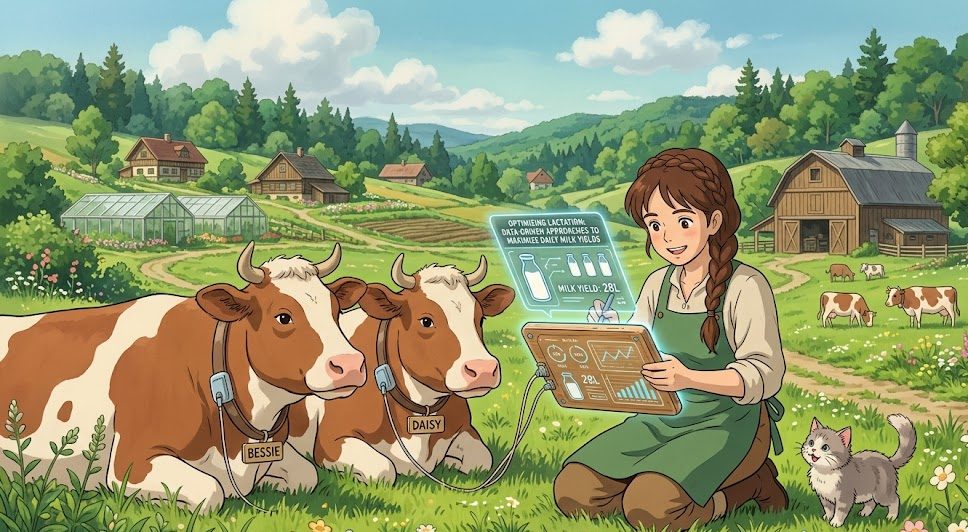
In the modern dairy industry, the difference between a farm that merely sustains itself and one that excels is found in the data. Maximizing daily milk yield is not a product of chance; it is the culmination of precise environmental control, nutritional accuracy, and proactive health management. As we transition into a new era of “smart farming,” the ability to harness metrics to optimize lactation curves has become the most powerful tool in a dairy owner’s arsenal.
This guide outlines the pillars of data-driven lactation management, designed to help you push your herd’s potential to its peak.
1. The Power of the Lactation Curve
Every cow follows a predictable lactation curve, but “average” is the enemy of optimization. You must understand the trajectory of your high-yielders versus your underperformers.
- Tracking Peak Flow: The peak yield typically occurs between 40 and 90 days into lactation. If your cows are peaking too early or too late, it indicates a flaw in your transition cow management.
- Persistency is Key: High yield is not just about the peak; it is about how slowly the yield drops after that peak. By tracking daily output, you can identify cows with poor persistency and adjust their dietary intake or health protocols before their production bottoms out.
2. Precision Nutrition: Feeding the Data
Milk production is essentially a metabolic process. If the inputs (feed) do not match the outputs (milk), the efficiency drops.
- Dry Matter Intake (DMI) Monitoring: DMI is the single most important predictor of milk yield. Use automated feeding systems or trough monitoring to ensure your cows are consuming their target DMI. A slight drop in DMI is often the first indicator of sub-clinical metabolic issues.
- Component-Based Feeding: Shift your strategy from feeding “the herd” to feeding “the production group.” Use data from your milk meters to categorize cows into specific nutritional groups. High-yielders require dense, high-protein rations, while late-lactation cows can thrive on more economical, forage-heavy diets.
3. The Role of Technology in Health Surveillance
Disease is the silent thief of milk production. A cow fighting an infection will prioritize her immune system over her udder.
- Automated Activity Monitoring: Wearable sensors that track rumination time and activity levels provide invaluable real-time data. A sudden decrease in rumination time is a leading indicator of digestive or metabolic distress (such as ketosis or displaced abomasum) long before it becomes clinically visible.
- Somatic Cell Count (SCC) Tracking: High SCC indicates mastitis, which can permanently damage udder tissue. By analyzing SCC data by quarter, you can identify specific environmental factors—such as bedding cleanliness or milking equipment malfunctions—that are compromising udder health.
4. Environmental Optimization
Cows are biological heat exchangers. If the environment is not ideal, they spend energy trying to maintain homeostasis rather than producing milk.
- Managing Heat Stress: Dairy cows have a narrow thermoneutral zone. Above 25°C, milk yield begins to decline. Use temperature-humidity index (THI) sensors to trigger automated cooling systems—misters and fans—the moment conditions approach the threshold.
- The Comfort Metric: Monitor “lying time.” Cows produce more milk when they are resting. Data shows that for every hour of additional lying time, a cow can produce up to 1-2 kg of additional milk. Ensure your stalls are correctly sized and the bedding is dry to encourage resting behavior.
5. Transition Cow Management: The Launchpad
The success of a lactation cycle is determined in the three weeks before and after calving (the transition period).
- Metabolic Profiling: Use blood analysis during the dry period to monitor calcium, beta-hydroxybutyrate (BHB), and NEFA levels. Cows that enter lactation with balanced metabolic markers are significantly more likely to achieve high peak yields and suffer fewer health complications.
- Consistent Routine: Any disruption—be it a change in group dynamics or a feed shift—during the transition period will reflect in the milk yield for the next 300 days. Keep management practices consistent to minimize stress.
6. Building a Data-Driven Culture
Collecting data is useless if it isn’t acted upon.
- The Feedback Loop: Establish a weekly review meeting with your farm team. Review the “Top 10” and “Bottom 10” producers. Discuss why the top performers are succeeding and implement those strategies across the board.
- Benchmarking: Compare your herd’s performance against regional and national averages. If your milk-per-cow-per-day is below the industry benchmark, treat it as a project rather than a failure. Identify the bottleneck—is it nutrition, health, or genetics?—and apply resources where the ROI will be the highest.
Final Thoughts: The Path to Excellence
Maximizing milk yield is a long-term game. It involves the integration of high-quality genetics, cutting-edge nutritional science, and an unyielding commitment to data collection.
When you treat every cow as an individual contributor to your farm’s bottom line, you gain a granular understanding of your operation that intuition alone cannot provide. By focusing on the small, daily adjustments—improving DMI by 0.5kg here, reducing heat stress by 2 degrees there—you create the compounding effect that defines a high-yield, high-efficiency dairy operation.