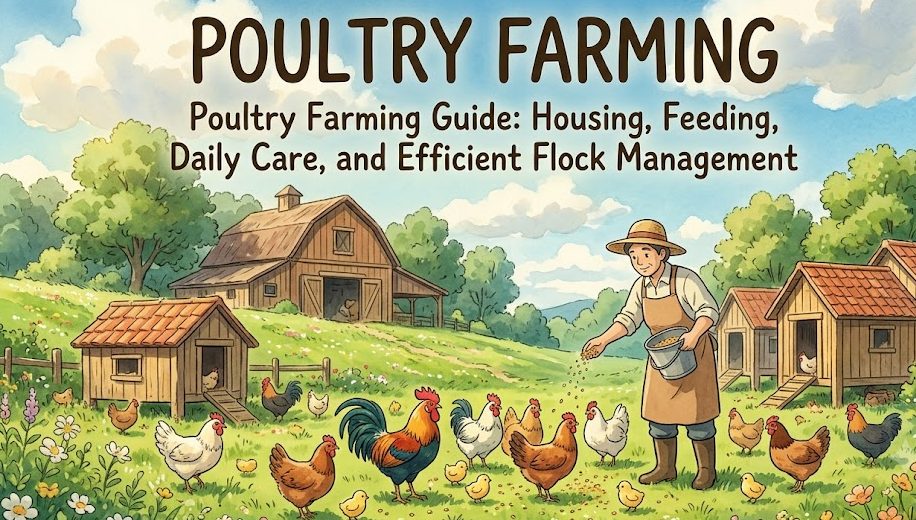
Poultry farming can be a practical and scalable agricultural business when birds are managed with the right combination of housing, nutrition, sanitation, observation, and daily routines. Whether a farm raises chickens for eggs, meat, breeding, or a combination of purposes, flock performance depends heavily on consistent management.
A successful poultry operation is not simply about providing feed and collecting eggs or raising birds to market weight. Farmers need to manage temperature, ventilation, water, litter, lighting, stocking density, biosecurity, equipment, and flock behavior throughout the production cycle.
Across the United States, poultry farms operate under a wide range of climates and production systems. A small backyard flock, a family farm, and a commercial poultry operation may use very different facilities, but many basic management principles remain similar.
The strongest poultry systems are organized around prevention, regular observation, efficient resource use, and quick responses when conditions change.
Decide What the Poultry Operation Will Produce
The first decision is the purpose of the flock.
Common poultry production systems include:
- Egg production
- Broiler meat production
- Breeding
- Replacement birds
- Specialty or pasture-based poultry
- Small-scale mixed production
The production goal influences almost every later decision.
For example, laying hens need a management system designed around consistent egg production, while broilers require an efficient growth environment. Breeding flocks have additional requirements related to reproduction and flock selection.
Before purchasing birds, farmers should understand the expected housing, feed, labor, equipment, and market requirements associated with the chosen production model.
Housing Comes Before the Birds
Good housing creates the foundation for flock management.
A poultry house should protect birds from severe weather while maintaining suitable airflow and environmental conditions.
Important housing considerations include:
- Adequate floor space
- Good ventilation
- Protection from predators
- Dry litter
- Safe flooring
- Easy access to feed and water
- Convenient cleaning
- Suitable lighting
- Secure doors and fencing
The building does not necessarily need to be complicated. What matters is whether it provides a safe, manageable environment.
Overcrowding should be avoided because excessive stocking density can make it harder to maintain litter quality, ventilation, and flock comfort.
Ventilation Is More Important Than It Looks
Fresh air is essential in poultry housing.
Poor ventilation can allow moisture, dust, odors, and unwanted gases to accumulate. Excess humidity can also contribute to wet litter and create conditions that increase health problems.
Ventilation should provide fresh air without exposing birds to damaging drafts.
Farmers should regularly check whether:
- Air feels excessively humid
- Litter is staying wet
- Condensation is appearing
- Odors are becoming strong
- Birds are clustering in unusual locations
- Air movement is adequate
During hot weather, ventilation becomes particularly important because moving air can help birds manage heat.
Temperature Management for Young Birds
Young poultry are more sensitive to temperature changes than mature birds.
Brooding requires careful management because chicks have limited ability to regulate body temperature during the early stages of life.
Farmers should observe chick behavior rather than relying only on a thermometer.
If chicks are consistently crowded together under the heat source, they may be too cold. If they avoid the heat source and remain around the edges, the area may be too warm.
A comfortable group of chicks should generally spread out and behave normally.
Brooder areas should also be clean, dry, safe, and protected from sudden environmental changes.
Feed Quality and Feeding Routine
Feed is one of the largest ongoing costs in poultry production, making efficient nutrition important for both bird health and farm economics.
Poultry diets should be appropriate for the birds’ age and production purpose.
Feed programs commonly change as birds move through different stages.
For example:
Starter feed supports young birds during early growth.
Grower feed supports development after the starter stage.
Layer feed is formulated for mature laying birds.
Finisher feed may be used during later stages of meat-bird production.
The exact feeding program should follow the recommendations for the breed, production system, and feed formulation.
Farmers should avoid making sudden feed changes unless there is a clear reason and the transition is managed appropriately.
Protect Feed From Moisture and Contamination
Feed quality can decline when storage conditions are poor.
Feed should be kept in clean, dry, secure storage areas that protect it from:
- Moisture
- Rodents
- Insects
- Mold
- Excessive heat
- Contamination
Storage containers should be checked regularly.
Old feed should not simply be mixed with fresh feed if it has become moldy, wet, or otherwise questionable.
Good feed storage reduces waste and protects the flock from avoidable problems.
Water Management Deserves Daily Attention
Birds need reliable access to clean water.
Water systems should be checked every day because even a short interruption can create serious problems, especially during hot weather.
Inspect:
- Drinkers
- Water lines
- Pressure systems
- Tanks
- Leaks
- Blockages
Water should remain reasonably clean and accessible to all birds.
Drinkers should also be positioned and maintained to reduce unnecessary litter wetness.
During periods of extreme heat, farmers should pay particular attention to water availability because poultry can become stressed quickly when environmental temperatures rise.
Lighting and Flock Behavior
Lighting influences poultry behavior and production, particularly in laying systems.
The appropriate lighting schedule depends on the birds’ age, production stage, housing system, and management goals.
Rather than making sudden changes, farmers should maintain a consistent program appropriate for the flock.
Bird behavior can also provide useful information.
Watch for:
- Excessive aggression
- Feather pecking
- Unusual crowding
- Birds avoiding certain areas
- Reduced feeding
- Reduced movement
- Sudden changes in activity
Behavioral changes can sometimes indicate environmental problems before physical symptoms become obvious.
Keep Litter Dry
Litter management is an important part of poultry housing.
Depending on the production system, materials such as wood shavings or other suitable bedding may be used.
The objective is to maintain a reasonably dry and manageable floor environment.
Wet litter can develop when:
- Drinkers leak
- Ventilation is inadequate
- Stocking density is too high
- Water spills
- Drainage is poor
- Humidity remains high
Farmers should identify the cause rather than simply adding more bedding.
If a drinker is leaking, adding bedding repeatedly will not solve the underlying problem.
Biosecurity for Poultry Farms
Poultry operations should take biosecurity seriously because diseases can spread rapidly through bird populations.
Biosecurity measures can include:
- Limiting unnecessary visitors
- Cleaning footwear
- Managing equipment movement
- Separating new birds
- Preventing contact with wild birds where appropriate
- Keeping feed protected
- Cleaning housing and equipment
- Monitoring bird health
Wild birds and rodents can create additional biosecurity challenges, particularly when they have access to feed or poultry housing.
New birds should be introduced according to an appropriate biosecurity plan and professional guidance.
Daily Flock Inspection
A daily inspection should be systematic rather than casual.
Walk through the flock and observe several areas.
First: Watch the Birds
Are they moving normally? Are they eating and drinking?
Second: Check the Environment
Look at temperature, airflow, litter, lighting, and water.
Third: Inspect Equipment
Check feeders, drinkers, fans, heaters, and other systems.
Fourth: Look for Unusual Birds
Identify birds that appear weak, isolated, injured, or significantly different from the rest of the flock.
Fifth: Record Important Changes
Keeping a simple record can help identify trends.
This routine can take only a short amount of time but can prevent small problems from being overlooked.
Managing Heat During Summer
Poultry are particularly sensitive to excessive heat because birds have limited ways to cool themselves.
During hot weather, farms should focus on:
- Reliable water
- Good ventilation
- Air movement
- Shade where appropriate
- Reducing unnecessary handling
- Monitoring flock behavior
- Maintaining suitable stocking density
Signs of heat stress can include increased panting, wings held away from the body, reduced activity, and changes in feeding behavior.
Severe heat events should be taken seriously, and farms should have a plan before temperatures rise.
Managing Cold Weather
Cold-weather management depends on bird age, housing, breed, and local conditions.
Young birds generally require much more careful temperature management than mature birds.
During winter, farmers should check:
- Heating systems
- Ventilation
- Drafts
- Water systems
- Bedding
- Building insulation
- Roof and wall condition
Ventilation should not be eliminated simply because temperatures are low. Fresh-air exchange remains important, but the system should be managed to avoid excessive drafts and moisture buildup.
Health Monitoring and Veterinary Care
Healthy poultry usually have consistent activity, feeding, drinking, and appearance.
Farmers should watch for:
- Sudden changes in feed intake
- Changes in water consumption
- Respiratory signs
- Reduced movement
- Unusual droppings
- Injuries
- Feather problems
- Sudden mortality
- Significant drops in egg production
If multiple birds become sick or mortality increases unexpectedly, professional veterinary assistance should be sought promptly.
Vaccination and disease-prevention programs should be developed according to the flock type, location, production system, and veterinary recommendations.
Egg Production Management
For laying flocks, egg collection and handling are important daily tasks.
Eggs should be collected regularly to reduce breakage and contamination.
Farmers should also monitor:
- Number of eggs produced
- Shell quality
- Egg size
- Broken eggs
- Changes in production
- Nest cleanliness
A sudden decline in egg production can sometimes indicate environmental, nutritional, health, or management problems.
Eggs intended for sale must also be handled according to applicable food-safety requirements.
Efficient Broiler Management
Meat-bird production focuses heavily on healthy growth and efficient feed use.
Important management factors include:
- Appropriate stocking density
- Feed access
- Water availability
- Temperature
- Ventilation
- Litter quality
- Bird health
- Growth monitoring
Farmers can track body weight at regular intervals to compare actual flock development with expected performance.
If birds are growing more slowly than expected, the cause should be investigated rather than simply increasing feed.
Possible factors include nutrition, environmental conditions, disease, water access, or stocking density.
Reduce Feed and Resource Waste
Efficiency is not only about increasing production. It is also about reducing unnecessary waste.
Farmers can monitor:
- Feed spills
- Water leaks
- Broken equipment
- Excessive bedding use
- Electricity consumption
- Mortality
- Unnecessary labor
Feeders should be adjusted appropriately so birds can access feed without excessive spillage.
Water systems should also be maintained carefully because leaks can increase both water consumption and litter problems.
Small improvements repeated every day can have a meaningful impact over an entire production cycle.
Keep Useful Flock Records
Records allow farmers to understand what is happening inside the operation.
Useful information can include:
- Number of birds
- Breed or strain
- Arrival date
- Feed consumption
- Water consumption
- Mortality
- Vaccinations
- Treatments
- Egg production
- Average body weight
- Environmental conditions
- Equipment problems
- Sale or processing dates
These records can help identify trends and make future flock planning more accurate.
For example, if a particular housing area consistently develops wet litter, the farmer can investigate ventilation, drinker placement, drainage, or stocking density.
A Practical Daily Poultry Routine
A simple routine can keep flock management organized.
Morning
Check birds, water, feed, temperature, ventilation, and equipment.
During the day
Monitor environmental conditions, especially during extreme heat or cold.
Afternoon
Inspect water systems, bird behavior, litter, and housing conditions.
Evening
Confirm that the flock has adequate feed, water, ventilation, and secure housing.
Weekly
Review records, equipment condition, mortality, feed use, flock performance, and sanitation.
This type of routine can be adapted to both small farms and larger operations.
Final Thoughts
Efficient poultry farming depends on consistency. Good housing, reliable water, appropriate nutrition, clean litter, ventilation, biosecurity, regular observation, and accurate records all work together to support a healthy flock.
The best poultry management system is not necessarily the most expensive one. It is the one that gives farmers enough control to maintain a safe environment, notice problems early, use resources efficiently, and respond quickly when conditions change.
For U.S. poultry producers, management practices should also be adapted to local climate, flock type, production goals, and applicable agricultural and food-safety requirements.
When daily care is organized and preventive management becomes part of the routine, poultry farmers can create a more stable production environment while improving the efficiency and long-term sustainability of their operation.